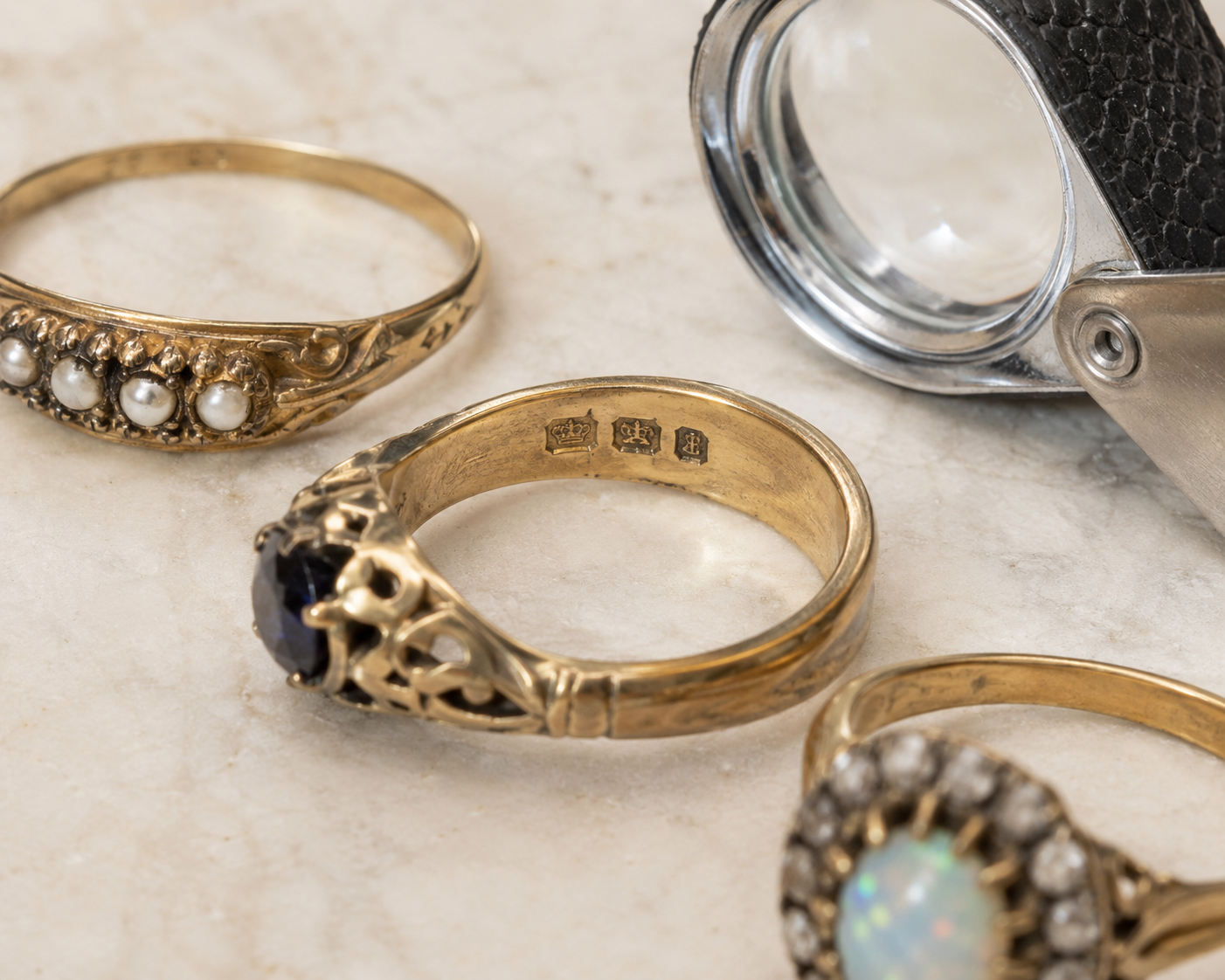
Why Some Antique Rings Don’t Have Hallmarks: A Buyer’s Guide
Jessica Spencer2026-08-04T18:42:31+00:00If you have ever looked inside an antique ring and found no hallmark, you are not alone.
It is one of the most common questions people ask when buying antique jewellery. Does no hallmark mean the ring is not real gold? Does it mean the piece is fake? Should every antique ring have a clear set of marks inside the band?
The short answer is no. A missing hallmark does not automatically mean a piece is not genuine. With antique jewellery, the story is often more complex.
Hallmarks are useful. They tell us important information about a piece, including its metal content and where it was tested. However, antique jewellery has often lived through decades, and sometimes well over a century, of wear, resizing, repair, and alteration. As a result, not every genuine antique ring arrives with a neat, readable hallmark.
In this guide, we explain why some antique rings do not have hallmarks, what that means for buyers, and how to approach unmarked antique jewellery with confidence.
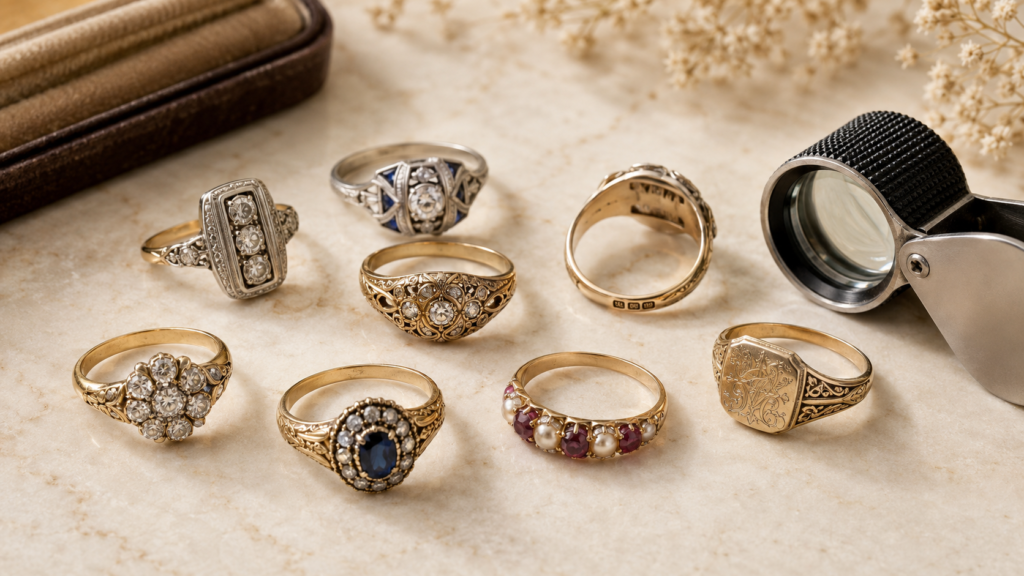
What is a hallmark?
A hallmark is a small official mark applied to precious metal jewellery. It confirms that the metal has been independently tested and meets the required standard.
In the UK, hallmarks are applied by an Assay Office. They are not simply decorative stamps, and they are not added by the shop selling the piece.
A modern UK hallmark usually tells you three key things:
Who submitted the item for hallmarking.
What precious metal the item is made from.
Which Assay Office tested the item.
You may also see a date letter, although this is not always present on modern pieces.
For example, a 9ct gold ring may carry a “375” mark. This means the gold content is 375 parts per thousand. An 18ct gold ring may carry a “750” mark, meaning 750 parts per thousand.
So, when a hallmark is present and readable, it can be very helpful. It gives buyers reassurance and helps jewellers describe the piece accurately.
However, antique jewellery does not always behave like modern jewellery.
Does every gold ring need a hallmark?
Most modern gold jewellery sold in the UK must be hallmarked if it is over the legal exemption weight and described as gold.
At the time of writing, the minimum hallmarking weight for gold is 1 gram. This means a gold item below 1 gram does not need a hallmark. Silver, platinum, and palladium have their own exemption weights.
So, it is not quite true to say that every single gold item must be hallmarked. A very tiny or lightweight gold item may fall below the compulsory hallmarking threshold.
For most rings, though, the weight will usually be over 1 gram. This means a modern gold ring being sold in the UK would normally need a recognised hallmark, unless another exemption applies.
This is where antique jewellery needs careful explanation.
The Hallmarking Act 1973 created the modern framework for UK hallmarking law. However, jewellery made before the modern system came fully into force can be more complicated.
Before the mid-1970s, many precious metal articles were treated differently. Some rings and other jewellery pieces may not have been stamped in the way we would expect today. There is also specific guidance around pre-1950 articles, because many older precious metal pieces were historically exempt from hallmarking.
That is why an older ring with no hallmark is not automatically suspicious.
It may have lost its marks through wear or resizing. It may have been made abroad. It may fall under an older exemption. Or it may have been made at a time when hallmarking rules were not applied in the same way as they are now.
The important thing is proper assessment. If a ring has no hallmark, a reputable seller should explain how the metal has been identified, whether it has been tested, and what evidence supports the age and description of the piece.
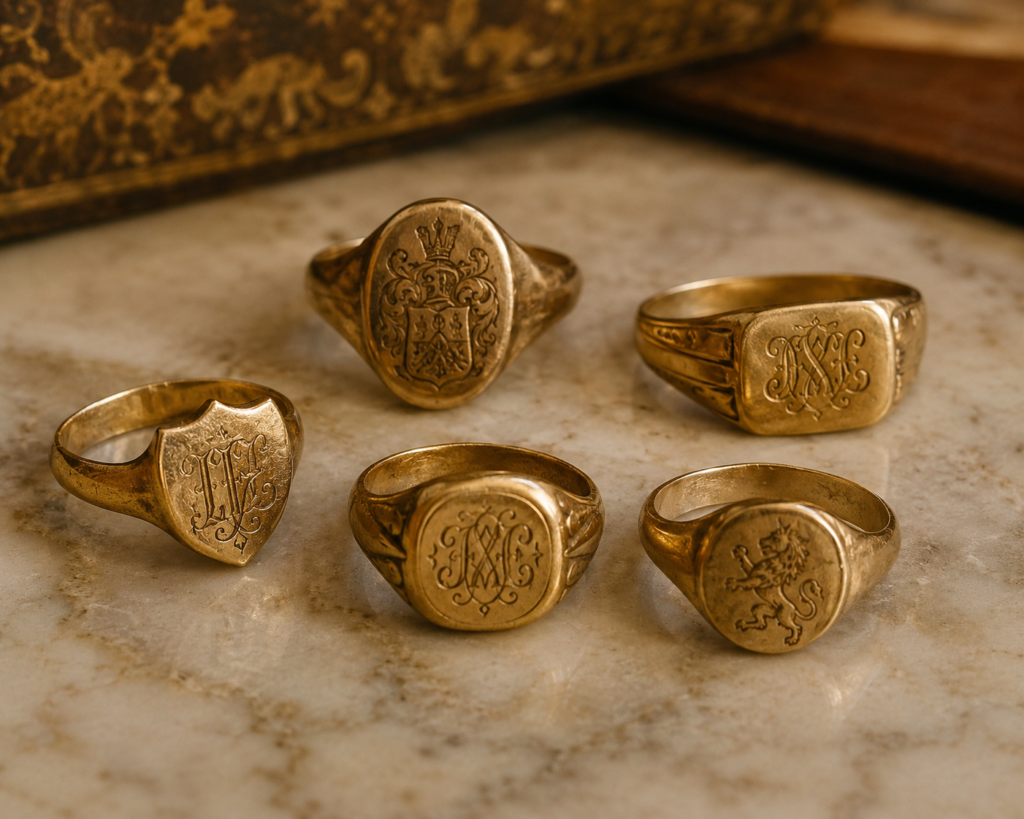
Why would an antique ring have no hallmark?
There are several reasons why a genuine antique ring may not have a clear hallmark.
1. The hallmark may have worn away
Rings are worn directly against the skin. They rub against other rings, hard surfaces, pockets, gloves, bags, and daily life.
Over decades, the inside of a band can become softened and polished by wear. Fine engraved details can fade. Stamps can become faint. In some cases, a hallmark is still there, but it is too worn to read clearly.
This is especially common on rings that have been worn every day for many years.
An engagement ring, wedding ring, or signet ring may have spent a lifetime on someone’s hand. That is part of its charm. However, it also means the original marks may no longer be sharp.
2. The ring may have been resized
Resizing is one of the most common reasons a hallmark disappears.
Hallmarks are often placed inside the shank of a ring. If a ring has been made larger or smaller, the jeweller may need to cut into that part of the band.
Sometimes the hallmark is removed entirely. Sometimes part of it remains. Sometimes the band has been reshaped so much that the mark becomes difficult to read.
This is particularly common with antique engagement rings and old wedding rings. Over time, they may have been altered to fit a new owner.
That does not make the ring less genuine. It simply tells us the piece has had a life.
3. The ring may predate modern hallmarking rules
The Hallmarking Act 1973 brought together much of the modern law around hallmarking in the UK. However, antique jewellery often predates this modern framework.
Some Victorian, Edwardian, Art Deco, and earlier pieces have clear hallmarks. Others do not.
Before the current system, some articles were exempt from hallmarking. In practice, this means some older rings were never stamped in the first place. Others may have had partial, inconsistent, or now-unreadable marks.
This is why it is important to assess the whole piece, not just the presence or absence of a stamp.
Age, construction, wear, setting style, gemstone cut, craftsmanship, and metal testing all help build a more complete picture.
4. The ring may have been made outside the UK
Not all antique jewellery sold in the UK was made here.
A ring may have French, Austro-Hungarian, American, Italian, or other continental marks. These can look very different from British hallmarks. Some are tiny. Some are placed in unusual areas. Some may be partial or difficult to identify.
In other cases, the piece may have entered the UK many decades ago with no recognised British hallmark at all.
This is why a ring can be genuine gold but not carry the type of hallmark a UK buyer expects to see.
5. The piece may be below the exemption weight
Some precious metal items do not need a hallmark if they fall below the legal weight threshold.
For gold, the current UK exemption weight is 1 gram. Very lightweight pieces may therefore not require a hallmark.
This is more common with small earrings, fine chains, delicate charms, and tiny settings. Rings are often above the gold threshold, but some very fine antique rings can be surprisingly light.
So, again, the absence of a hallmark does not automatically mean something is wrong.
6. The ring may have been repaired or altered
Antique jewellery often carries evidence of past repair.
A ring may have had a new shank added. It may have had the shoulders strengthened. It may have been rebuilt after wear. It may also have been altered from another piece of jewellery.
For example, an old gemstone cluster may have started life as a brooch, pendant, or different style of ring. Later, someone may have converted it into a ring.
These changes are part of antique jewellery history. However, they can affect marks, metal sections, and original hallmarks.
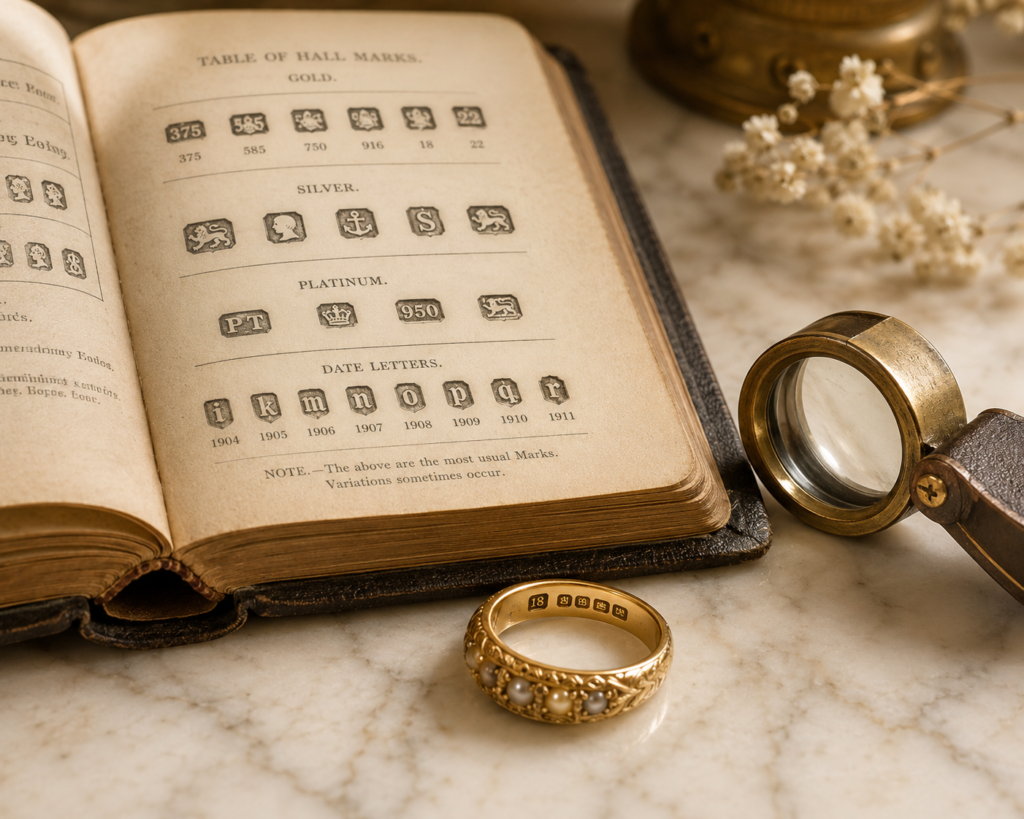
Does no hallmark mean a ring is fake?
No. A missing hallmark does not automatically mean a ring is fake.
It means the piece needs proper assessment.
An experienced jeweller will look at several things, not just the hallmark. These may include the metal, the construction, the setting style, the stones, the wear pattern, the weight, the colour of the gold, and any signs of repair or alteration.
The hallmark is one clue. It is not the only clue.
This is especially true with antique jewellery. A ring can be unmarked and still be genuine gold. It can be antique and still have no readable date letter. It can also have a later-added mark, a partial mark, or a mark that does not match the exact period of the design.
That is why trust matters when buying antique jewellery.
How do jewellers check unmarked antique jewellery?
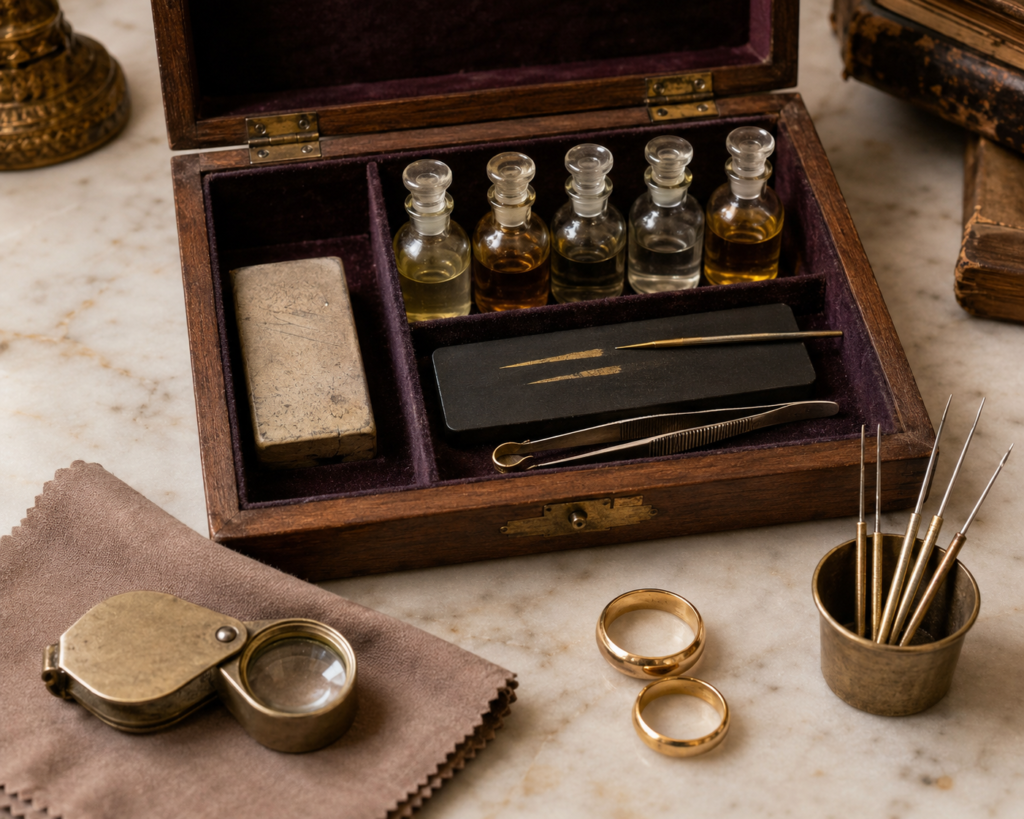
When a piece has no clear hallmark, jewellers use other methods to assess it.
This may include metal testing, close inspection under magnification, and looking at the way the piece has been made. The colour and behaviour of the metal can also give clues, especially when combined with years of experience handling antique jewellery.
The setting style matters too. Georgian settings, Victorian shoulders, Edwardian gallery work, Art Deco geometry, old cut diamonds, rose cut stones, and hand-pierced details can all help build a picture.
Of course, no one should rely on style alone. A ring should be described honestly and carefully. If a piece is tested as 9ct gold, 15ct gold, 18ct gold, platinum, or silver, that should be made clear.
When we list antique jewellery, we look at the full piece. If a hallmark is present, we mention it. If a piece is unmarked but tested, we describe that too.
Should you buy an antique ring with no hallmark?
Yes, if it has been assessed properly and described honestly.
Many beautiful antique rings have no readable hallmark. Some are over 100 years old. Some have been loved, resized, repaired, and passed down. Others have foreign marks or partial marks that are difficult to read.
That history does not make them less special. In many cases, it makes them more interesting.
However, you should always buy from someone who explains what they know and what they do not know.
Before buying an unhallmarked antique ring, it is worth asking:
Has the metal been tested?
Is there any visible mark at all?
Has the ring been resized or repaired?
What age or period does the seller believe it to be?
Are there clear photographs of the setting and shank?
Is the condition described properly?
A good seller will not avoid these questions. They will answer them clearly.
Hallmarked vs unhallmarked: which is better?
A hallmark is always useful, but it does not automatically make one antique ring better than another.
A fully hallmarked Victorian ring can be wonderful. So can an unmarked Georgian ring with beautiful old cut diamonds. A clear hallmark helps with dating and metal identification, but it is not the only measure of quality, beauty, or value.
With antique jewellery, the best pieces often have a balance of things:
Good craftsmanship
Beautiful design
Wearable condition
Genuine age
Quality stones
Honest description
A sense of character
A hallmark can support that story. It does not create it on its own.
Why antique jewellery needs a different mindset
When you buy a new ring, you expect clean paperwork, modern hallmarks, and a piece that has never been worn.
Antique jewellery asks for a different mindset.
These pieces have already lived. They may have been worn through marriages, celebrations, family milestones, and ordinary daily routines. They may have crossed countries. They may have been resized for someone else’s hand. They may have tiny signs of wear that show they were treasured, not stored away.
That is part of the appeal.
Antique jewellery is not about factory perfection. It is about survival, craftsmanship, beauty, and history.
So, if a ring has no hallmark, do not panic. Look closer. Ask questions. Read the description. Consider the seller. Then look at the piece as a whole.
Final thoughts
A missing hallmark does not automatically mean an antique ring is fake, poor quality, or not gold. It simply means there is more to understand.
Some hallmarks wear away. Some are lost during resizing. Some pieces were made abroad. Some fall below exemption weight. Some are old enough to sit within a more complicated part of hallmarking history.
The most important thing is honest assessment.
At Aladdin’s Cave Jewellery, we handle antique and vintage jewellery every day. We look carefully at each piece, including its metal, age, stones, condition, and craftsmanship. When a hallmark is present, we include it. When a piece is unmarked but tested, we say so clearly.
Because with antique jewellery, the story is rarely found in one tiny mark.
Sometimes, it is found in the whole piece.


Jessica Spencer
Third Generation Antique Jewellery Specialist
Jessica Spencer is part of the third generation behind Aladdin's Cave Jewellery in Leeds. She specialises in antique and vintage jewellery and writes practical guides based on real pieces handled in the shop and decades of family experience.