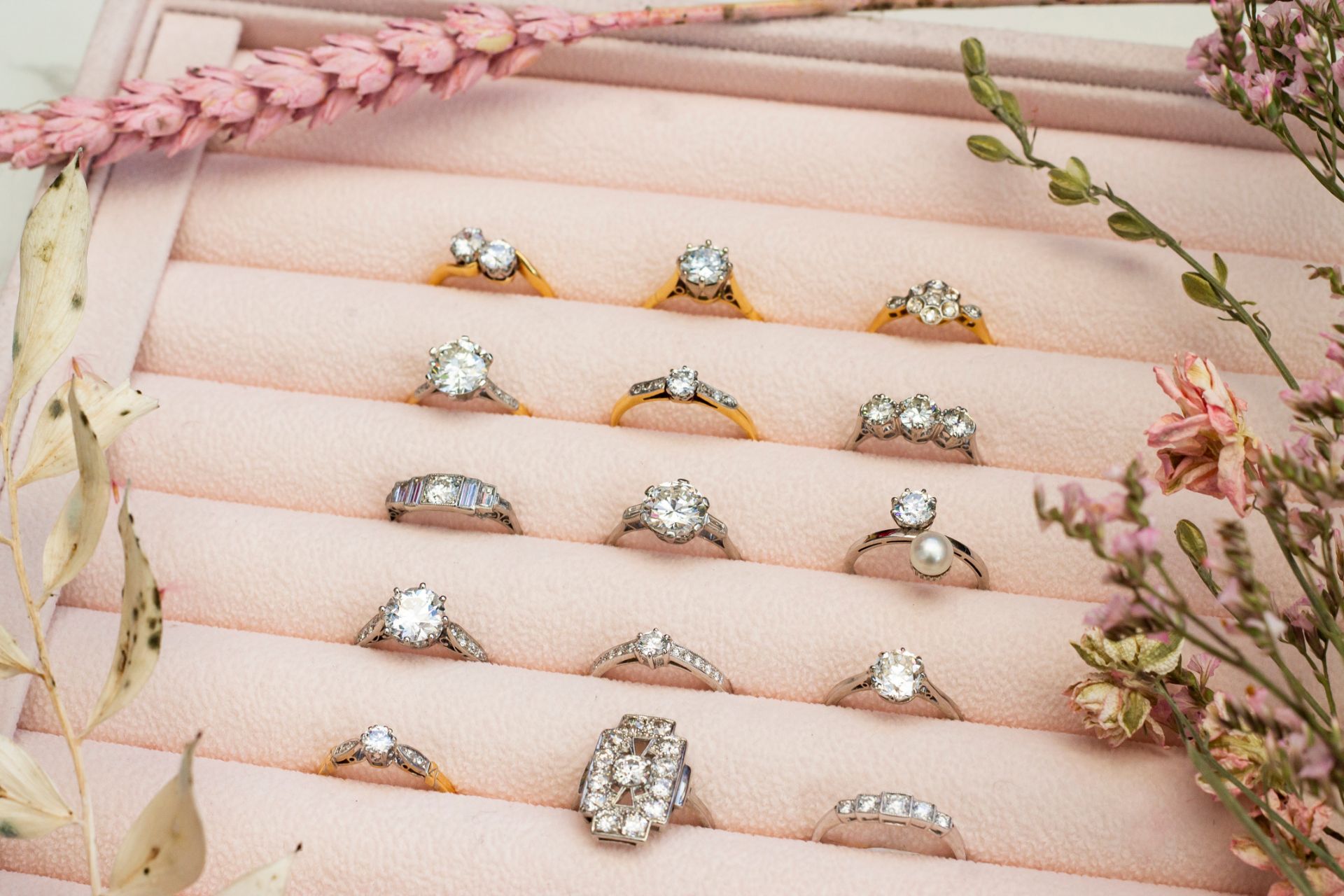
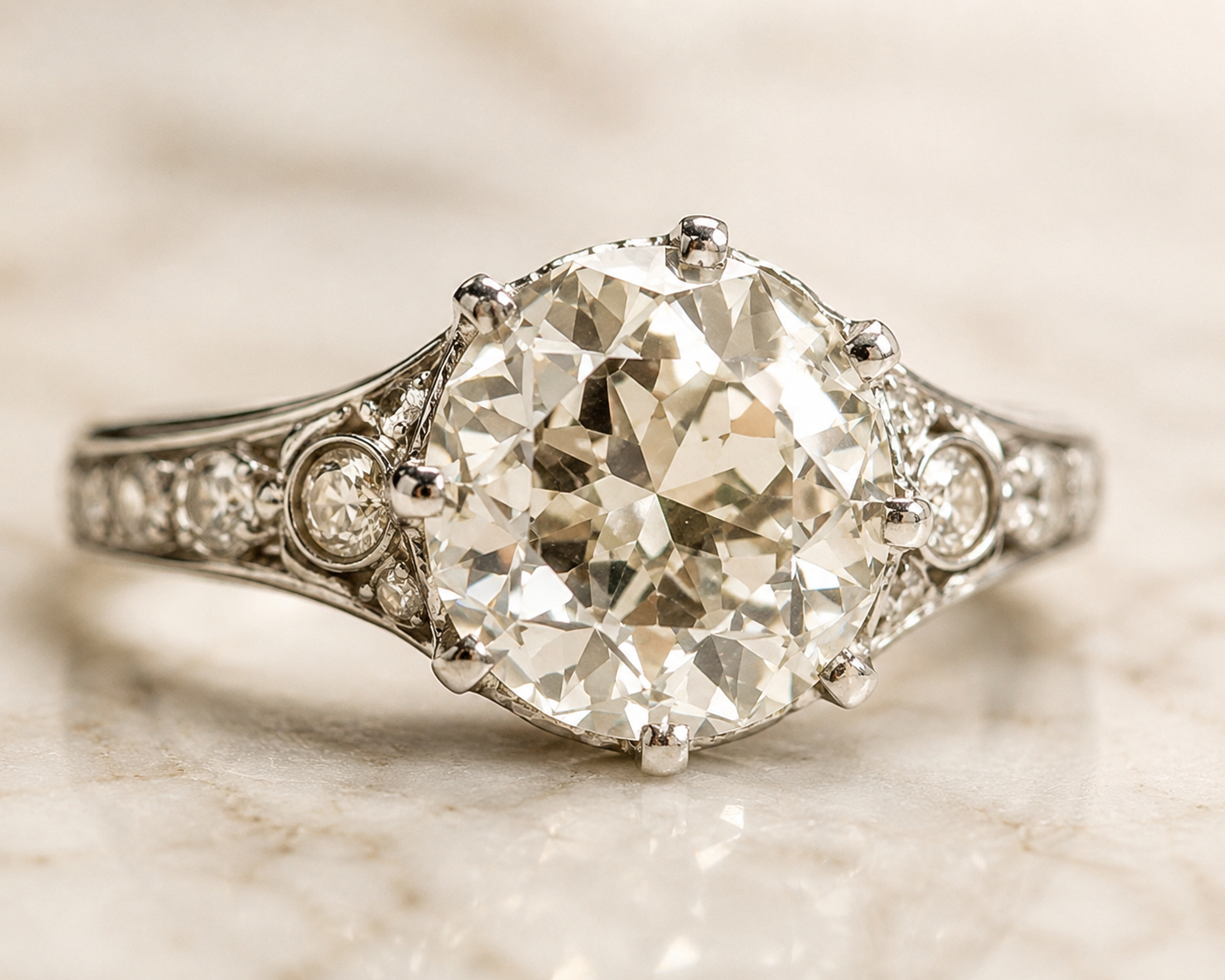
The Complete Guide to Antique Diamond Cuts
Jessica Spencer2026-08-21T07:45:56+00:00Before modern brilliant-cut diamonds became the standard, every diamond was cut entirely by hand. Without lasers, computer modelling or precise measuring tools, early diamond cutters relied on skill, experience and patience to shape each stone individually. The result was a series of historic cuts that possess a character and charm unlike anything produced today.
From the softly shimmering Rose Cut to the bold flashes of an Old Mine Cut and the refined brilliance of an Old European Cut, each style reflects the craftsmanship, technology and tastes of its era. No two antique diamonds are exactly alike, making them as individual as the jewellery they adorn.
Whether you’re researching a family heirloom, choosing an antique engagement ring or simply curious about how old-cut diamonds differ from modern stones, understanding these historic cutting styles can help you appreciate why antique diamonds continue to captivate collectors more than a century later.
In this guide, we’ll explore the five diamond cuts you’re most likely to encounter in antique and vintage jewellery, explaining how to identify each one, when it was popular and what makes it unique.
The Evolution of Diamond Cutting
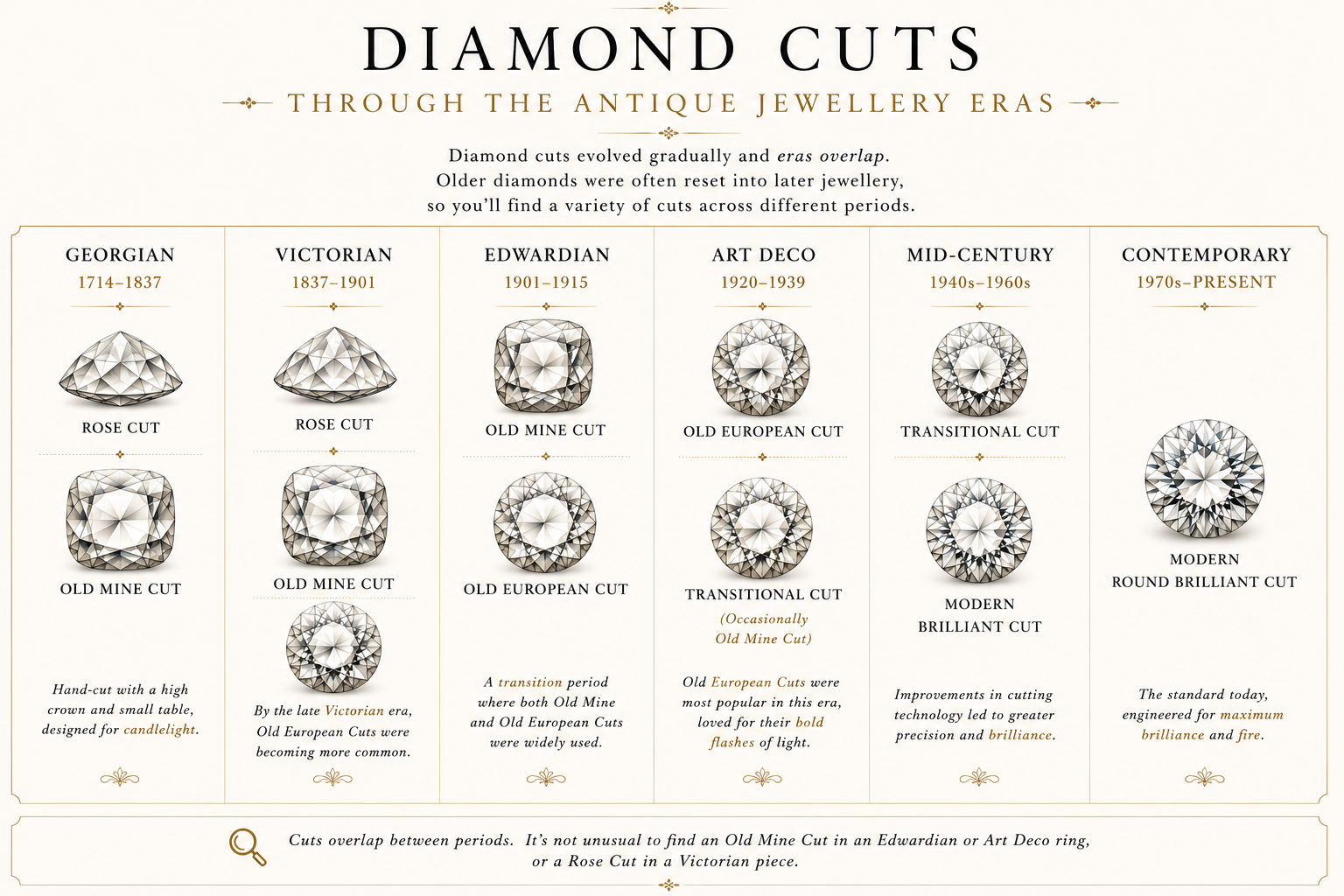
The history of diamond cutting is a story of continual refinement. As techniques improved and new technology became available, cutters gradually developed ways of capturing more light, increasing brilliance and creating greater consistency between stones.
The earliest diamonds were valued primarily for their rarity rather than their sparkle. Over time, cutters began experimenting with additional facets, improved symmetry and deeper proportions, allowing diamonds to reflect and refract light more effectively.
Lighting also influenced these developments. Jewellery worn during the Georgian and Victorian periods was often viewed by candlelight, favouring cuts that produced broad flashes of light and colourful fire rather than the rapid scintillation associated with modern brilliant-cut diamonds.
By the early twentieth century, advances in cutting equipment and a better understanding of optics paved the way for increasingly precise proportions. Transitional Cuts bridged the gap between traditional hand-cut diamonds and the Modern Brilliant Cut, which remains the most popular diamond cut today.
Although diamond cutting evolved over centuries, older cuts never became obsolete. Today, collectors continue to seek them out for their individuality, craftsmanship and unmistakable antique character.
Rose cut diamonds
The Rose Cut is one of the oldest and most distinctive diamond cuts you’ll encounter in antique jewellery. First developed in the 16th century, it takes its name from the unfolding petals of a rose, with triangular facets rising across a gently domed surface. Unlike modern diamonds, Rose Cuts have a flat base rather than a pavilion, giving them a softer, more understated sparkle.
While they may appear less brilliant under modern lighting, Rose Cut diamonds were designed for a very different world. By candlelight, their broad facets create a gentle shimmer that perfectly suited Georgian and early Victorian jewellery. Today, collectors value them for their romantic appearance, historic charm and unmistakable antique character.

How to identify Rose Cut diamonds
If you’re examining a piece of antique jewellery, here are the easiest features to look for:
- A flat underside rather than a pointed pavilion.
- A gently domed top covered with triangular facets.
- A soft shimmer rather than intense brilliance.
- Often found in closed-back or foil-backed Georgian jewellery, although later examples also exist

Old Mine Cut Diamonds
The Old Mine Cut is one of the most recognisable and sought-after antique diamond cuts. Developed during the 18th century and remaining popular throughout the Georgian and Victorian eras, it was cut entirely by hand, long before the precision of modern diamond cutting.
Unlike today’s perfectly symmetrical brilliant-cut diamonds, each Old Mine Cut has its own individual character. They were shaped to preserve as much of the original rough crystal as possible, resulting in their distinctive cushion-shaped outline, high crown, deep pavilion and open culet. These features create broad flashes of light and exceptional fire rather than the rapid sparkle associated with modern diamonds.
Although Old Mine Cuts are no longer produced commercially, they remain highly prized by collectors and those looking for an engagement ring with genuine antique charm.

How to identify Old Mine Cut diamonds
If you’re looking at an antique diamond and wondering whether it’s an Old Mine Cut, these are the features to look for:
- A soft cushion or slightly squarish outline rather than a perfectly round shape.
- A noticeably high crown, giving the diamond greater depth.
- A small table compared with modern diamonds.
- A deep pavilion and an open culet, often visible when looking directly through the stone.
- Broad, chunky facets that produce bold flashes of white light and colourful fire.
Because every Old Mine Cut was fashioned by hand, it’s completely normal to see slight variations in symmetry and proportions. These subtle imperfections are part of their appeal and often help distinguish genuine antique diamonds from modern reproductions.

Old European Cut Diamonds (Old Cuts)
The Old European Cut( often simply referred to as an old cut) is one of the most celebrated antique diamond cuts. Developed in the late 19th century, it marked a significant step towards the modern brilliant cut while retaining the unmistakable character of a hand-cut diamond.
Cut entirely by hand, Old European Cut diamonds were designed to maximise beauty under candlelight and the softer illumination of the period. Their high crown, small table and open culet create broad flashes of white light and vibrant fire rather than the rapid sparkle seen in modern diamonds. While they are generally rounder and more symmetrical than earlier Old Mine Cuts, each stone still carries subtle variations that reflect the skill of the individual cutter.
Today, Old European Cut diamonds are highly sought after by collectors and those looking for an engagement ring with genuine antique character. They offer the perfect balance between historic craftsmanship and exceptional light performance, making them one of the most enduringly popular antique diamond cuts.

How to identify Old European Cut Diamonds
Old European Cut diamonds share some characteristics with modern brilliant cuts, but there are several features that make them easy to recognise once you know what to look for:
- A round outline with hand-cut symmetry.
- A small table compared with a modern brilliant.
- A high crown that gives the stone greater depth.
- An open culet, often visible as a small facet in the centre of the diamond when viewed face-up.
- Large, chunky facets that produce bold flashes of light and colourful fire.
Unlike modern diamonds, Old European Cuts were fashioned individually by hand, so slight differences in proportions and symmetry are entirely normal and form part of their charm.

Transitional Cut Diamonds
As the name suggests, the Transitional Cut represents the link between the Old European Cut and the Modern Brilliant Cut. Developed during the 1920s and 1930s, these diamonds reflect a period of rapid innovation, as improved cutting techniques and a growing understanding of light performance began to influence diamond design.
While Transitional Cuts still retain the hand-cut character of earlier diamonds, they introduce many of the features associated with modern brilliant cuts. They typically have a larger table, a lower crown and improved symmetry, producing a brighter, livelier appearance while preserving some of the broad flashes and fire that make antique diamonds so distinctive.
Although Transitional Cuts were only produced for a relatively short period, they are highly regarded today for combining vintage charm with a sparkle that feels surprisingly modern.

How to identify Transitional Cut Diamonds
Transitional Cut diamonds share characteristics with both Old European and Modern Brilliant Cuts, making them easy to recognise once you know what to look for.
Look for these features:
- A round outline with noticeably improved symmetry.
- A larger table than a typical Old European Cut.
- A lower crown that gives the stone a slightly flatter profile.
- A very small or closed culet.
- More precise faceting, producing a blend of broad antique flashes and finer scintillation.
Because Transitional Cuts were still cut by hand, individual stones can vary in their exact proportions, but they almost always display a clear move towards the precision of modern diamond cutting.

Modern Brilliant Cut Diamonds
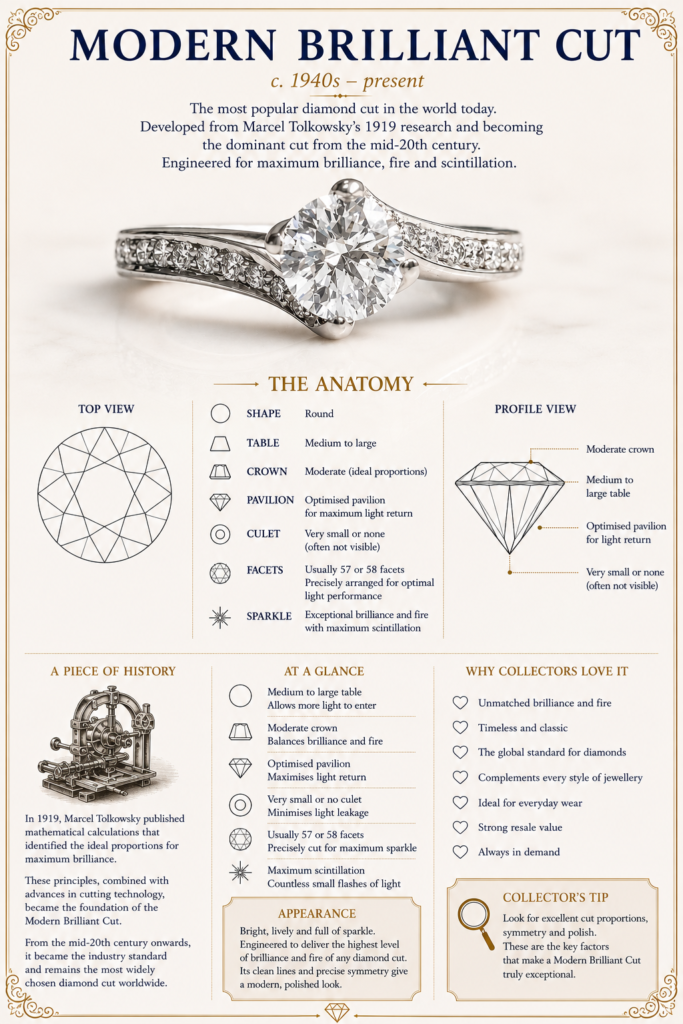
The Modern Brilliant Cut is the diamond shape most people recognise today. Developed from the cutting innovations of the early 20th century and refined throughout the mid-century, it was designed using a greater understanding of diamond optics to maximise brilliance, fire and scintillation.
Unlike antique diamonds, which were cut entirely by hand and often varied from one stone to the next, Modern Brilliant Cuts are produced to precise proportions using advanced cutting technology. Their carefully calculated facet arrangement is designed to return as much light as possible to the viewer, creating the bright, lively sparkle that has become synonymous with modern diamond jewellery.
Today, the Modern Brilliant Cut remains the world’s most popular diamond cut and serves as the benchmark against which all other round diamonds are compared.
How to identify a Modern Brilliant Cut Diamond
Modern Brilliant Cut diamonds are characterised by their precision and consistency.
Look for these features:
- A perfectly round outline.
- A medium to large table.
- A moderate crown with carefully proportioned angles.
- A very small or closed culet, often invisible without magnification.
- Usually 57 or 58 precisely aligned facets, designed to maximise light return.
Unlike earlier hand-cut diamonds, Modern Brilliant Cuts display a high degree of symmetry, with every facet positioned to optimise brilliance and sparkle.
Antique vs Modern: Which Diamond Cut Should You Choose?
There is no single “best” diamond cut, only the one that best reflects what you value most.
Some people are drawn to the precision and brilliance of a Modern Brilliant Cut, while others fall in love with the individuality and craftsmanship of an antique diamond. Each cut tells a different story, and understanding those differences can help you choose a diamond you’ll continue to appreciate for years to come.
Choose an antique cut if…
An antique diamond is about far more than sparkle. Every Old Mine, Old European and Rose Cut diamond was fashioned by hand, meaning no two stones are ever exactly alike. Slight variations in symmetry, facet placement and proportions aren’t imperfections, they’re part of the diamond’s history and character.
Collectors often love antique diamonds because they feel individual. Their broad facets create slower, bolder flashes of light, and many people describe them as having a warmth and personality that’s difficult to replicate in modern stones. If you appreciate craftsmanship, history and jewellery with a story to tell, an antique cut may be the perfect choice.
Choose a Modern Brilliant Cut if…
If your priority is maximum brilliance and light performance, a Modern Brilliant Cut is difficult to beat. Carefully calculated proportions and precise facet alignment allow these diamonds to return light exceptionally efficiently, producing the bright sparkle most people associate with a diamond today.
For buyers who prefer perfect symmetry, consistency and a clean contemporary appearance, the Modern Brilliant Cut remains the benchmark.
Looking for the best of both worlds?
Many buyers find themselves somewhere in between.
An Old European Cut offers much of the charm and individuality of an antique diamond while delivering excellent fire and brilliance, making it one of the most versatile historic cuts.
A Transitional Cut sits between the Old European and the Modern Brilliant, combining improved symmetry and a brighter sparkle with the subtle character that only a hand-cut diamond can provide.
Our perspective
Working with antique jewellery every day, we’ve learned that choosing a diamond isn’t simply about comparing specifications, it’s about finding the stone that speaks to you.
Some people fall instantly for the soft shimmer of a Rose Cut. Others are captivated by the bold flashes of an Old Mine Cut or the balanced beauty of an Old European Cut. And for many, the precision and brilliance of a Modern Brilliant Cut feels exactly right.
Whichever you choose, understanding the story behind the cut allows you to appreciate not just how a diamond sparkles, but how centuries of craftsmanship and innovation shaped the way it looks today.

Frequently Asked Questions About Diamond Cuts
What is an old cut diamond?
The term old cut diamond is commonly used to describe hand-cut diamonds produced before the Modern Brilliant Cut became the industry standard. While it can refer to several historic cutting styles, it is most often used to describe Old European Cut diamonds. Antique jewellers may also use the term more broadly to include Old Mine Cuts and other early hand-cut diamonds. Unlike modern diamonds, old cut diamonds were shaped individually by hand, giving each stone its own unique character and proportions.
What is the difference between an Old Mine Cut and an Old European Cut?
Although both are antique diamond cuts, they have several distinct differences. Old Mine Cuts are typically cushion-shaped with a squarer outline, while Old European Cuts are generally rounder and more symmetrical. Old European Cuts also represent a later stage in the evolution of diamond cutting and are often brighter due to their improved symmetry and facet arrangement. Both retain the broad flashes and individuality that collectors love, but they each have their own distinctive appearance
Do antique diamonds sparkle differently?
Yes. Antique diamonds were cut to perform under candlelight and softer natural lighting rather than the bright artificial lighting we experience today. Their larger, hand-cut facets create broad flashes of white light and colourful fire, whereas modern brilliant cuts produce a faster, more intense sparkle known as scintillation. Neither is inherently better, it’s simply a different style of light performance.
What is an open culet?
An open culet is a small polished facet at the very bottom of many antique diamonds. When viewed face-up, it can sometimes appear as a tiny circle or octagon in the centre of the stone. This feature is commonly found in Old Mine and Old European Cut diamonds and is one of the easiest ways to identify many genuine antique diamonds.
Are Old European Cut diamonds valuable?
Yes. Their value depends on the same factors as any diamond, including carat weight, colour, clarity and condition, but genuine Old European Cut diamonds are often highly sought after because they are no longer produced. Their hand-cut craftsmanship, historic character and growing popularity among collectors and buyers looking for unique engagement rings all contribute to their desirability.
Are Transitional Cut diamonds rare?
Transitional Cut diamonds were produced for a relatively short period during the early 20th century, making them less common than both Old European and Modern Brilliant Cuts. They are particularly appealing to buyers who appreciate antique jewellery but also enjoy the increased brilliance and symmetry that foreshadow modern diamond cutting.
Can antique diamonds be recut?
They can, but many collectors advise against it. Recutting an antique diamond usually removes original material and permanently alters the historic craftsmanship that makes the stone special. While recutting may improve modern light performance, it can reduce the diamond’s historical significance and appeal to collectors.
Which antique diamond cut is best for an engagement ring?
There is no single best choice, it depends on what you value most. Old European Cuts are often chosen because they offer an excellent balance of antique character and sparkle. Old Mine Cuts appeal to those who love individuality and bold flashes of light, while Rose Cut diamonds are perfect for buyers looking for a softer, more understated look. The right choice is ultimately the one that suits your personal style.
How can I tell if my diamond is an antique cut?
The easiest clues are the diamond’s shape, facet pattern, table size, crown height and culet. Antique diamonds often display larger facets, higher crowns and visible culets, with slight variations in symmetry caused by hand cutting. The age and style of the setting can also provide valuable clues, although the diamond itself is usually the most reliable indicator. If you’re unsure, an experienced antique jeweller or gemmologist can help identify the cut.


Jessica Spencer
Antique Jewellery Specialist
Jessica Spencer is part of the third generation at Aladdin's Cave Jewellery in Leeds. Her guides are based on the real antique jewellery handled in the shop and decades of family experience.