Antique Jewellery Through the Eras: Georgian to Art Deco
Jessica Spencer2026-08-21T07:44:55+00:00If you’ve ever picked up an old ring, brooch or pendant and wondered, “How old is this?”, you’re not alone. It’s one of the questions we’re asked most often.
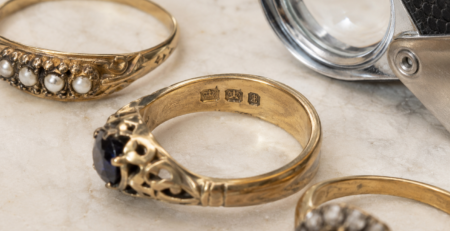
Sometimes a hallmark gives us the answer immediately. More often, dating antique jewellery involves putting together a series of clues: the way it was made, the metal used, the setting, the gemstones, the diamond cuts and, perhaps most obviously, the style.
From the handcrafted jewellery of the Georgian period to the bold geometry of Art Deco, each era left its mark.
This guide looks at four of the major periods you’re likely to encounter in antique jewellery and, more importantly, how to begin telling them apart.
In this guide
Antique Jewellery Eras at a Glance
Can You Tell How Old Jewellery Is Just by Looking at It?
How Can You Tell if Jewellery is Georgian?
How Can You Tell if Jewellery is Victorian?
How Can You Tell if Jewellery is Edwardian?
How Can You Tell if Jewellery is Art Deco?
Victorian vs Edwardian vs Art Deco: What Should You Look For?
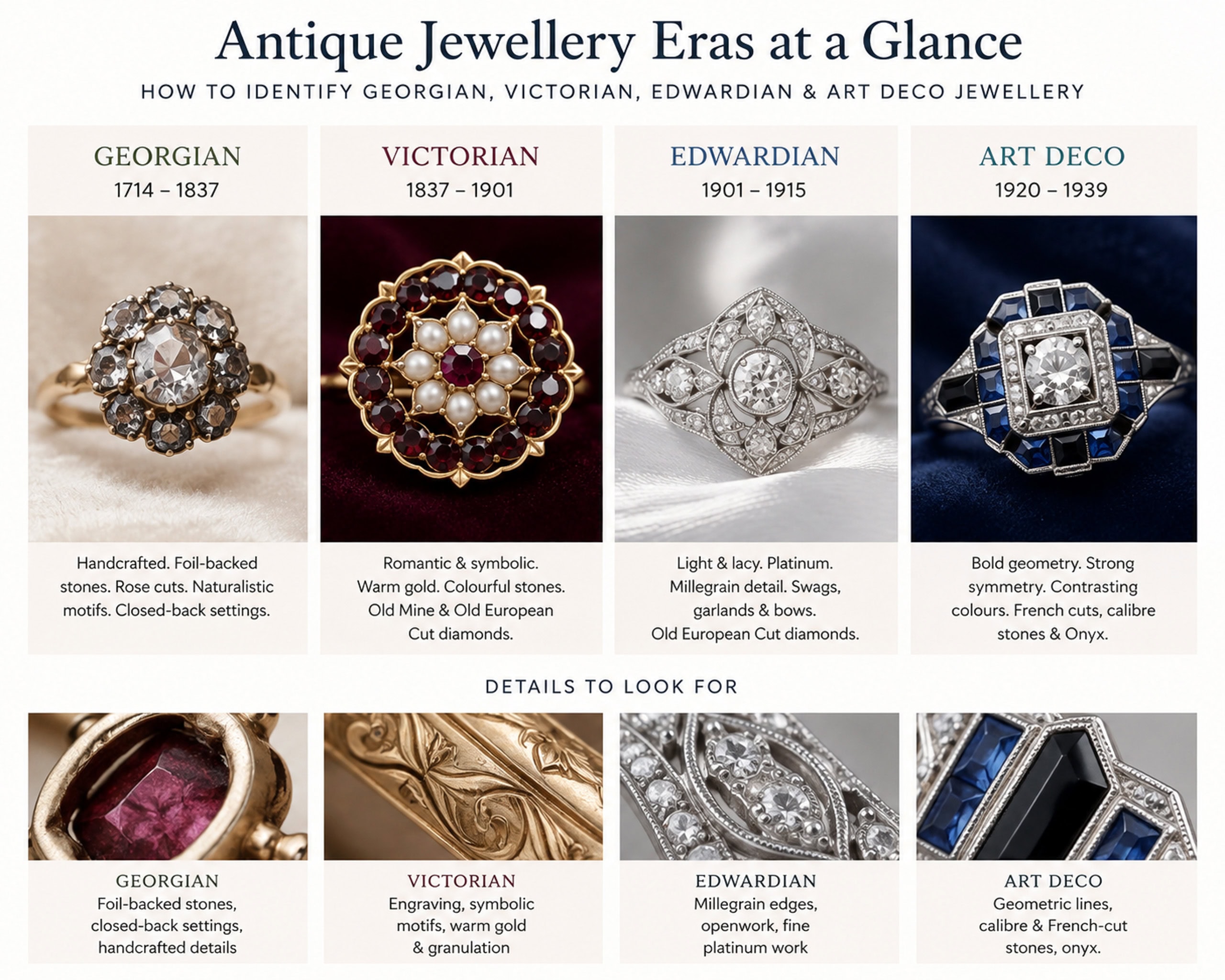
Antique Jewellery Eras at a Glance
Georgian: 1714–1837
Victorian: 1837–1901
Edwardian: c.1901–1915
Art Deco: c.1920–1939
These dates are useful guides rather than absolute dividing lines. Jewellery styles evolved gradually, and pieces made during transitional periods can show characteristics of more than one era.
Can You Tell How Old Jewellery Is Just by Looking at It?
Sometimes, but style should never be considered in isolation.
When we examine a piece of antique jewellery, we’re looking for several clues at once:
- Hallmarks and maker’s marks
- Metal and construction
- Diamond and gemstone cuts
- Settings and stone-setting techniques
- Motifs and design
- Evidence of hand manufacture
- Wear, alterations and repairs
An old diamond doesn’t necessarily mean an old ring, either. Antique stones have frequently been reset into later jewellery, while older pieces may have been altered or repaired during their lifetime.
The best way to date jewellery is therefore to consider all the evidence together.
How Can You Tell if Jewellery is Georgian?
Georgian jewellery dates from 1714 to 1837 and is considerably less commonly encountered than jewellery from the periods that followed.
Most Georgian jewellery was made by hand, often using techniques that give surviving pieces a wonderfully individual appearance.
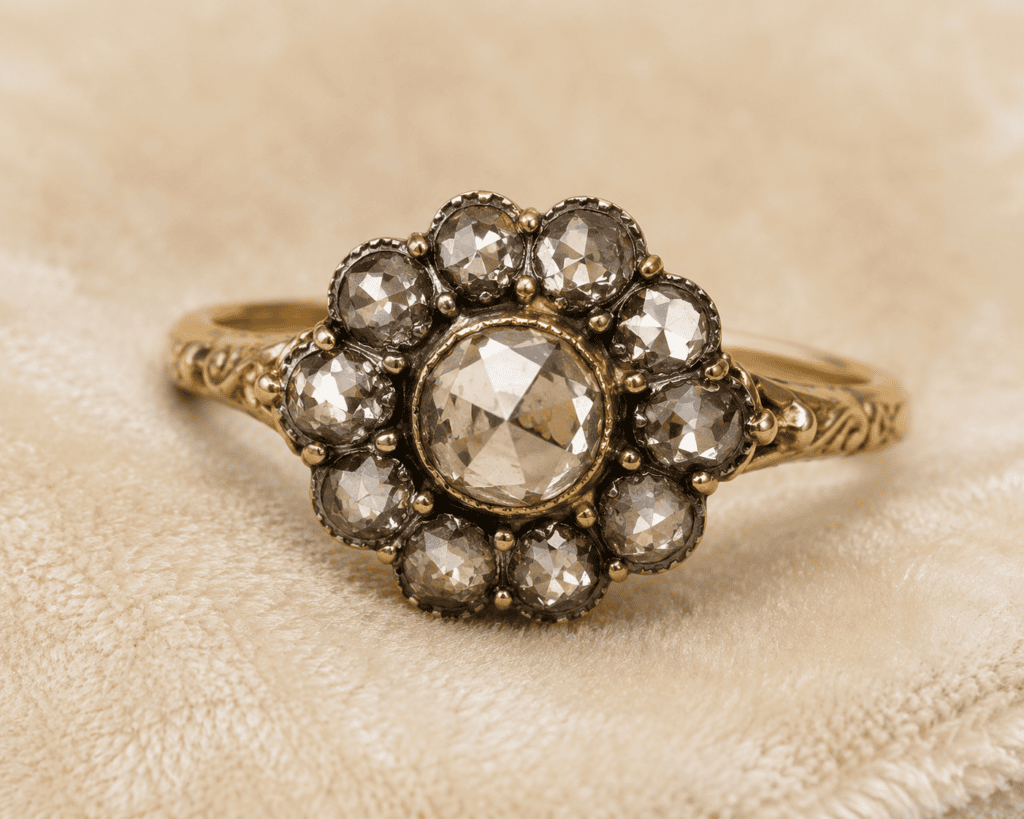
What does Georgian jewellery look like?
Look for:
- Hand-fabricated settings and construction
- Silver-topped gold, particularly in diamond jewellery
- Closed-back settings
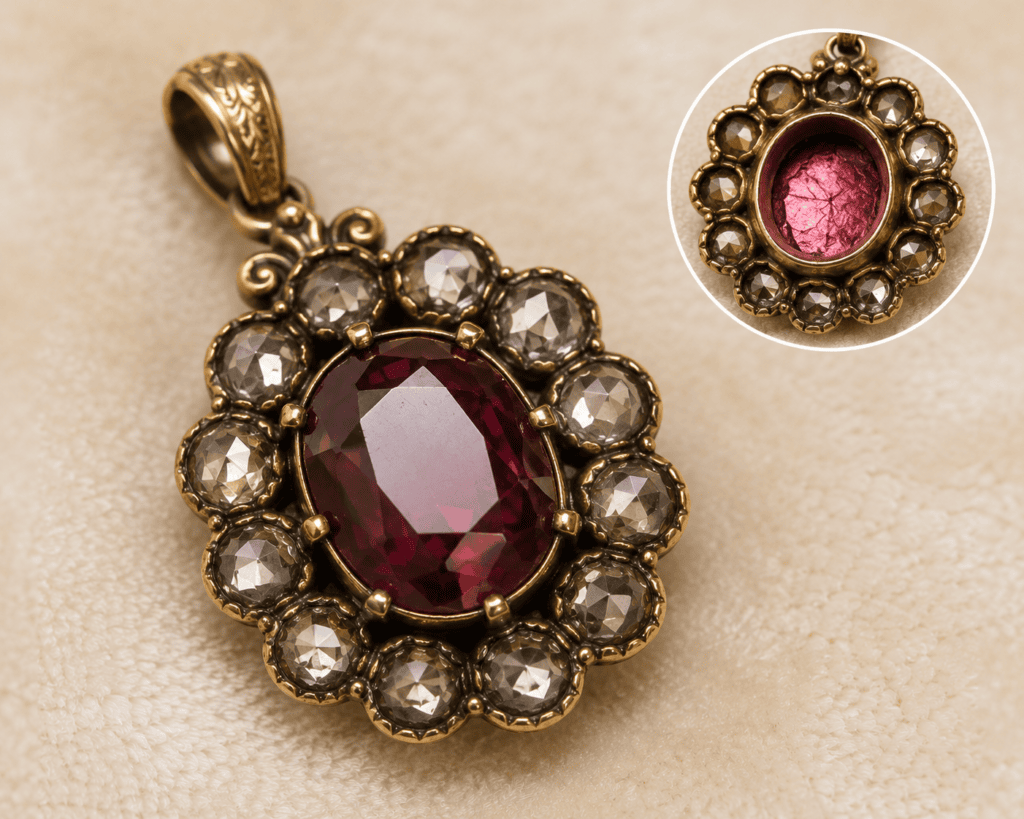
- Foil-backed gemstones
- Rose-cut and old mine-style diamonds
- Richly coloured gemstones
- Naturalistic motifs such as flowers, leaves and bows
Georgian diamond jewellery can look quite different from the brilliant, white sparkle we’re accustomed to today. Rose cuts and early old mine-style diamonds were cut by hand, often specifically to perform in candlelight.
Why are some Georgian gemstones foil-backed?
Foil was sometimes placed behind gemstones to intensify their colour and reflect light back through the stone.
This is also why you need to be particularly careful cleaning genuinely old jewellery. Water entering a closed-back, foil-backed setting can damage the foil and dramatically alter the appearance of the stone.
Is Georgian jewellery always hallmarked?
No. The absence of a hallmark does not automatically mean a piece isn’t Georgian.
Hallmarking practices and legal requirements were different, and many surviving pieces are unmarked. Construction and materials can therefore be particularly important when assessing Georgian jewellery.
Because genuine Georgian pieces are now approaching or exceeding two centuries old, alterations and repairs are also common.
How Can You Tell if Jewellery Is Victorian?
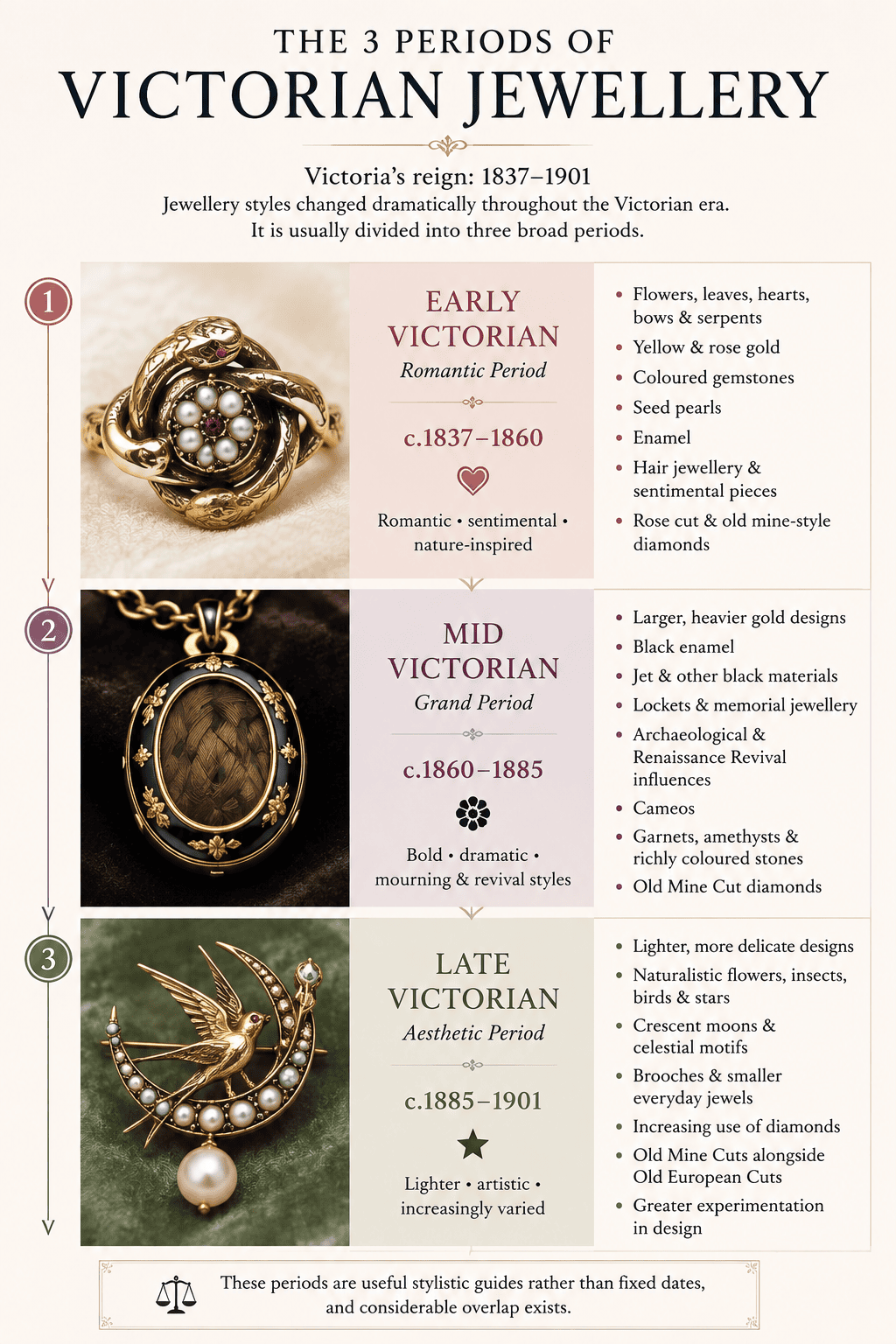
Victorian jewellery covers the reign of Queen Victoria from 1837 to 1901.
That’s more than 60 years, which explains why there isn’t really one “Victorian look”. Jewellery from 1840 can be dramatically different from jewellery made in 1895.
Broadly, the period is often divided into three stylistic phases: Romantic, Grand and Aesthetic.
What does Victorian jewellery look like?
You’ll commonly encounter:
- Yellow and rose gold
- Flowers, leaves, hearts and other naturalistic motifs
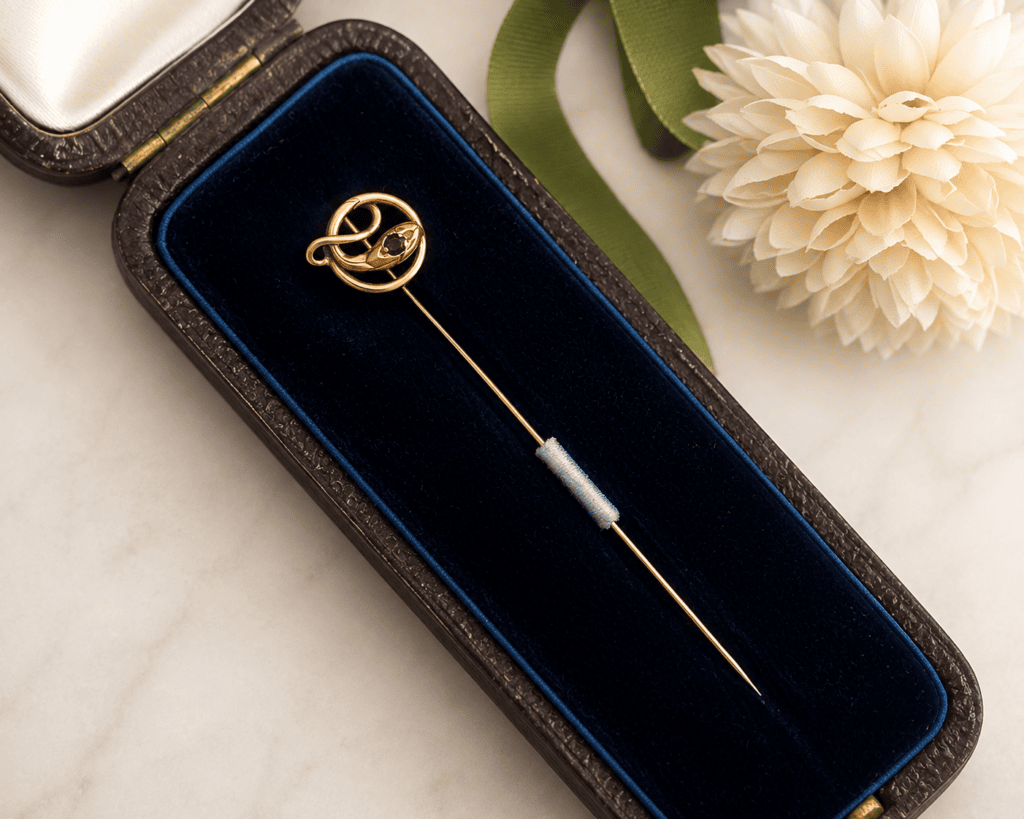
- Snakes and serpents
- Stars and celestial motifs
- Lockets
- Mourning jewellery
- Engraving and decorative goldwork
- Pearls and coloured gemstones
- Old Mine Cut and, later, Old European Cut diamonds
Victorian jewellery was often highly symbolic. Jewellery wasn’t simply decorative; it could communicate love, remembrance, friendship and mourning.
Why are there so many snakes in Victorian jewellery?
Snake jewellery became particularly fashionable after Prince Albert gave Queen Victoria a serpent engagement ring.
The snake biting or encircling its own tail could symbolise eternity, making it an appropriate romantic motif. Snakes continued to appear in rings, bracelets, brooches and necklaces throughout the Victorian period.
What is Victorian mourning jewellery?
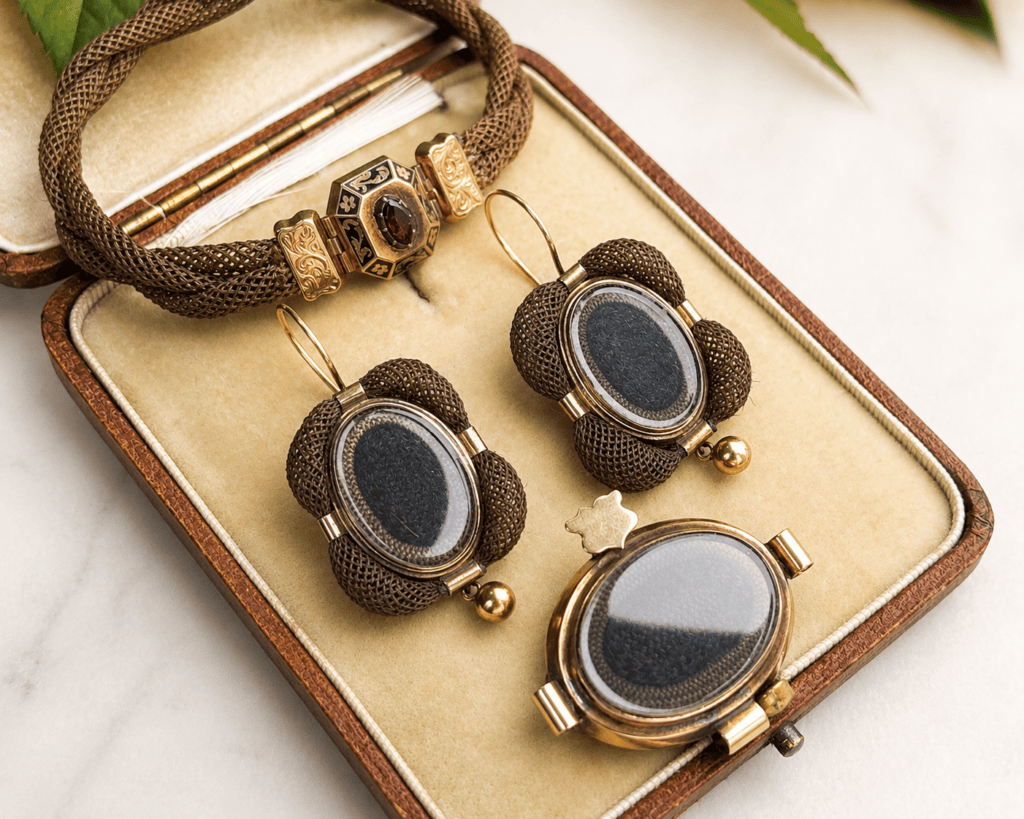
Mourning became an important part of Victorian culture, particularly following the death of Prince Albert in 1861.
Black materials such as jet were used extensively, while mourning pieces could also incorporate enamel, hairwork, inscriptions or photographs.
Not every piece of Victorian black jewellery is mourning jewellery, however. Jet and other black materials were also worn simply because they were fashionable.
What diamonds were used in Victorian jewellery?
Old Mine Cut diamonds are strongly associated with Victorian jewellery, particularly earlier and mid-century pieces.
By the late Victorian period, increasingly round Old European Cuts began to emerge as developments in diamond-cutting technology allowed greater consistency and symmetry.
You can read more about the evolution from Rose Cuts through to the Modern Brilliant in our Complete Guide to Antique Diamond Cuts.
Why Can Two Victorian Pieces Look Completely Different?
Because Victorian jewellery evolved enormously over Queen Victoria’s long reign.
Early Victorian or Romantic jewellery tends to be sentimental and naturalistic, with flowers, snakes, hearts and colourful gemstones.
The middle or Grand period saw heavier, more dramatic designs alongside the growth of mourning jewellery.
By the later Victorian period, tastes had changed again. Jewellery could become lighter and more varied, and improved manufacturing and diamond-cutting techniques introduced styles that begin to hint at what was coming next.
This is why simply describing something as “Victorian style” doesn’t tell you very much.
How Can You Tell if Jewellery Is Edwardian?
Edwardian jewellery is associated with the early 20th century, approximately 1901 to 1915.
If Victorian jewellery can be rich and decorative, Edwardian jewellery often feels remarkably light.
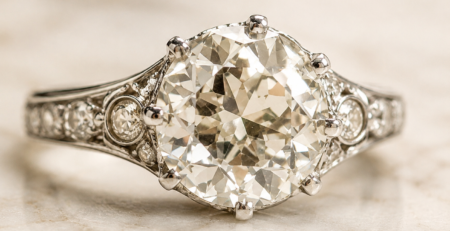
Advances in platinum working allowed jewellers to create extremely fine settings capable of holding diamonds securely without the visual weight of earlier gold settings.
The result was jewellery that could resemble lace.
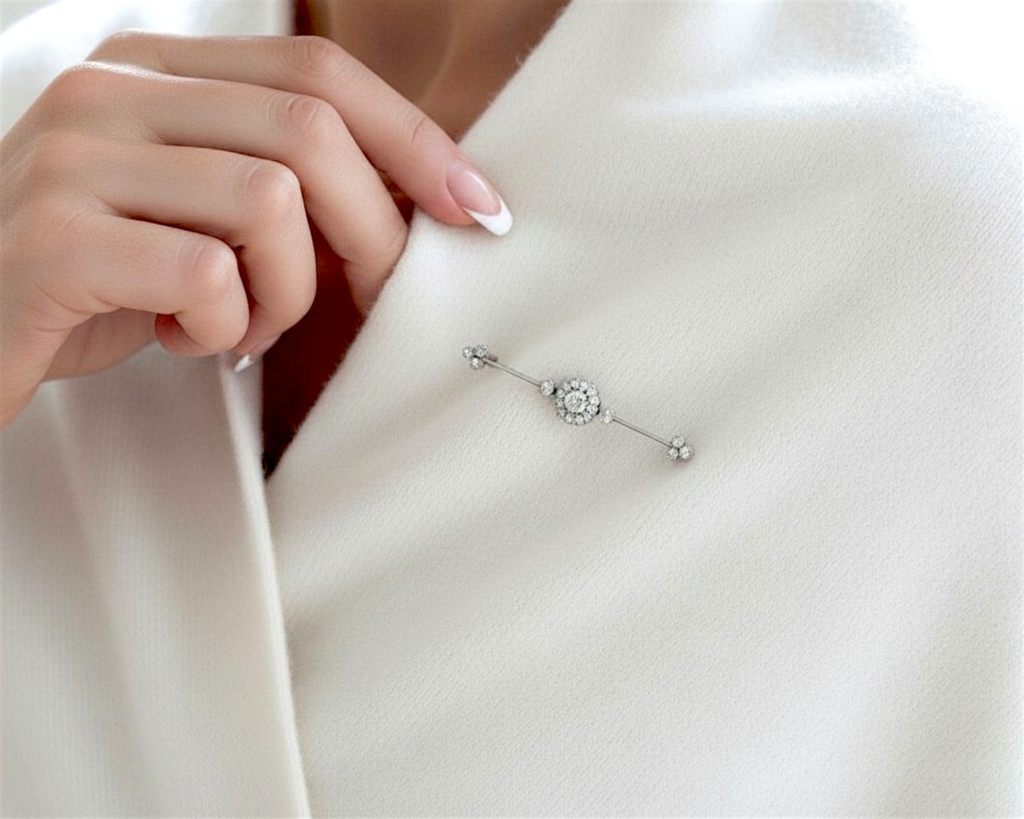
What does Edwardian jewellery look like?
Look for:
- Platinum
- Fine openwork
- Millegrain detailing
- Garland and bow motifs
- Swags and ribbons
- Diamonds and pearls
- Old European Cut diamonds
- Delicate, highly detailed settings
- Predominantly white-on-white designs
The overall impression is usually one of delicacy and refinement.
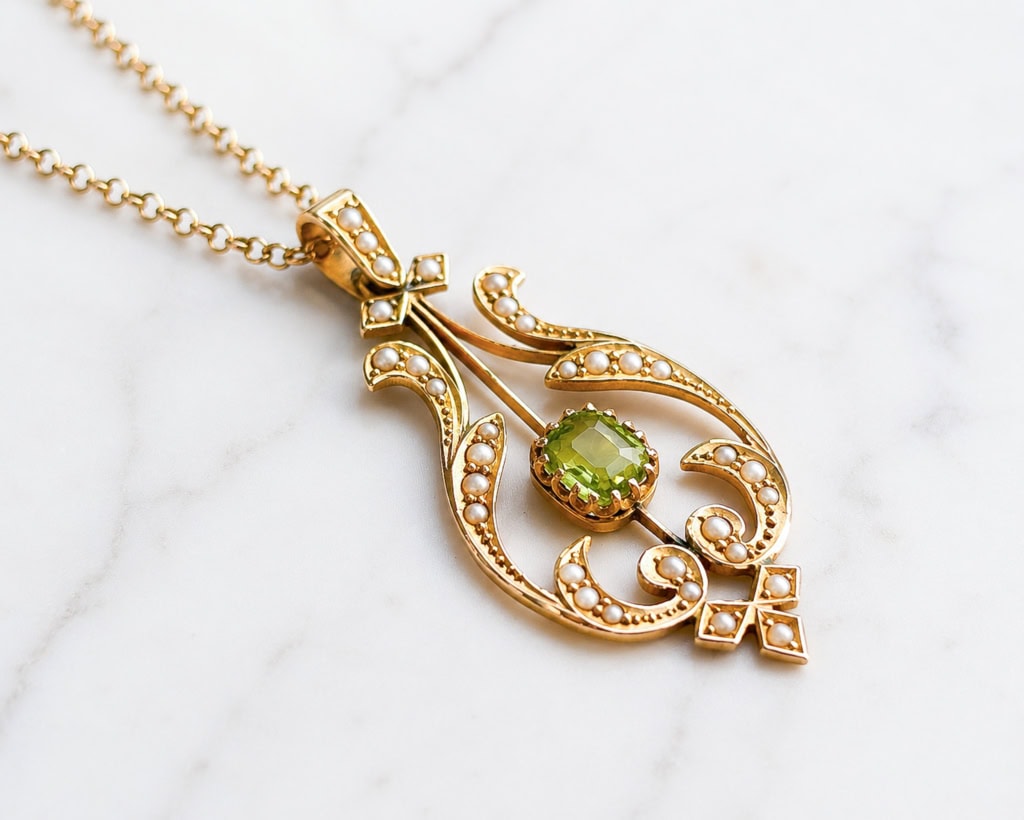
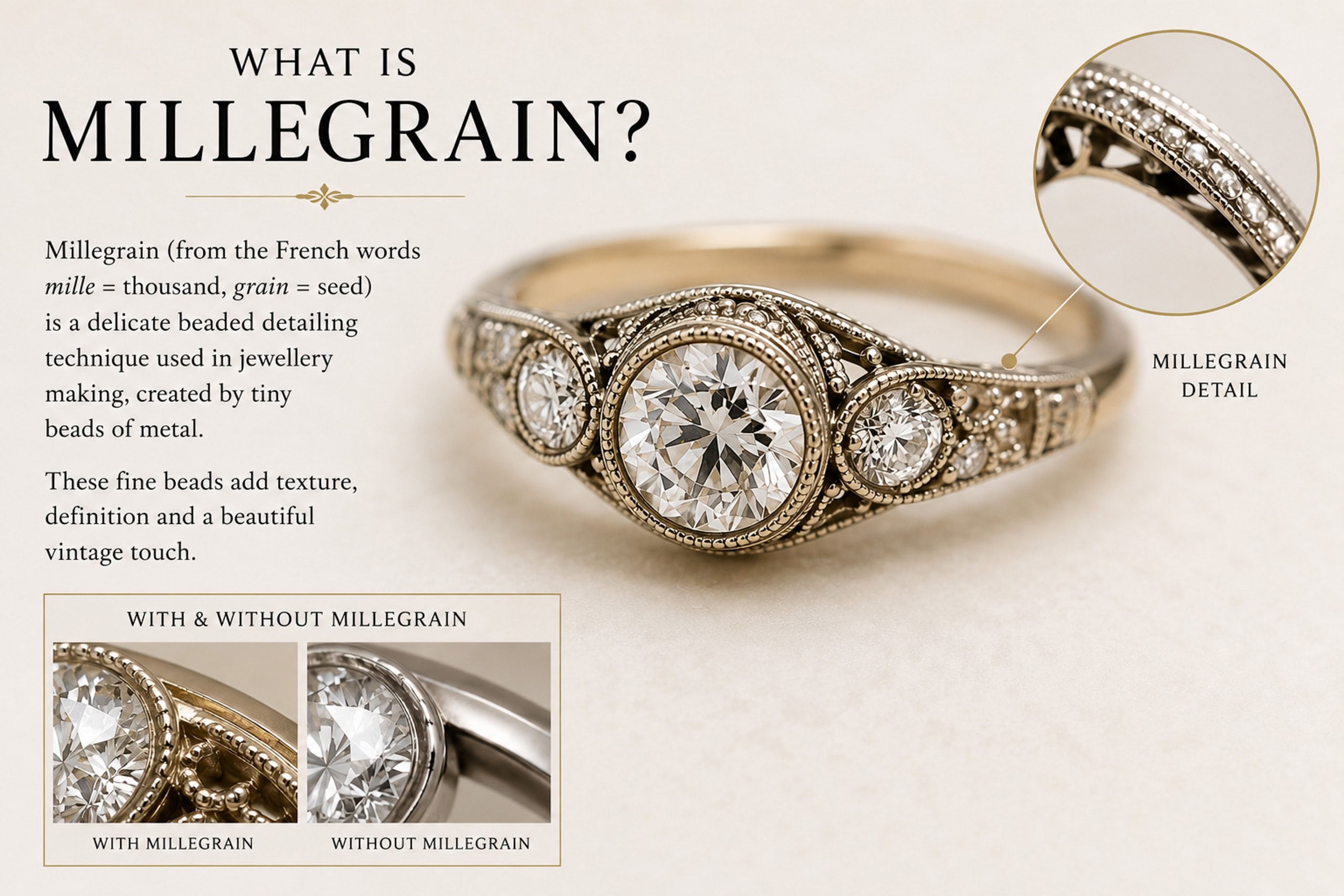
What is millegrain?
Millegrain is the tiny beaded edge you often see around stones or along the edges of platinum settings.
The technique became particularly associated with Edwardian and later Art Deco jewellery and allowed jewellers to give very fine settings an additional decorative finish.
If you look closely at an Edwardian diamond ring, you’ll often see those tiny rows of beads framing the stones.
How Can You Tell Edwardian and Art Deco Jewellery Apart?
This is where it gets interesting, because the two periods share several characteristics.
Both can feature:
- Platinum
- Diamonds
- Millegrain
- Fine openwork
- White-on-white colour schemes
The difference is often in the lines of the design.
Edwardian jewellery tends to be flowing, delicate and romantic. Think bows, garlands, ribbons, flowers and lace.
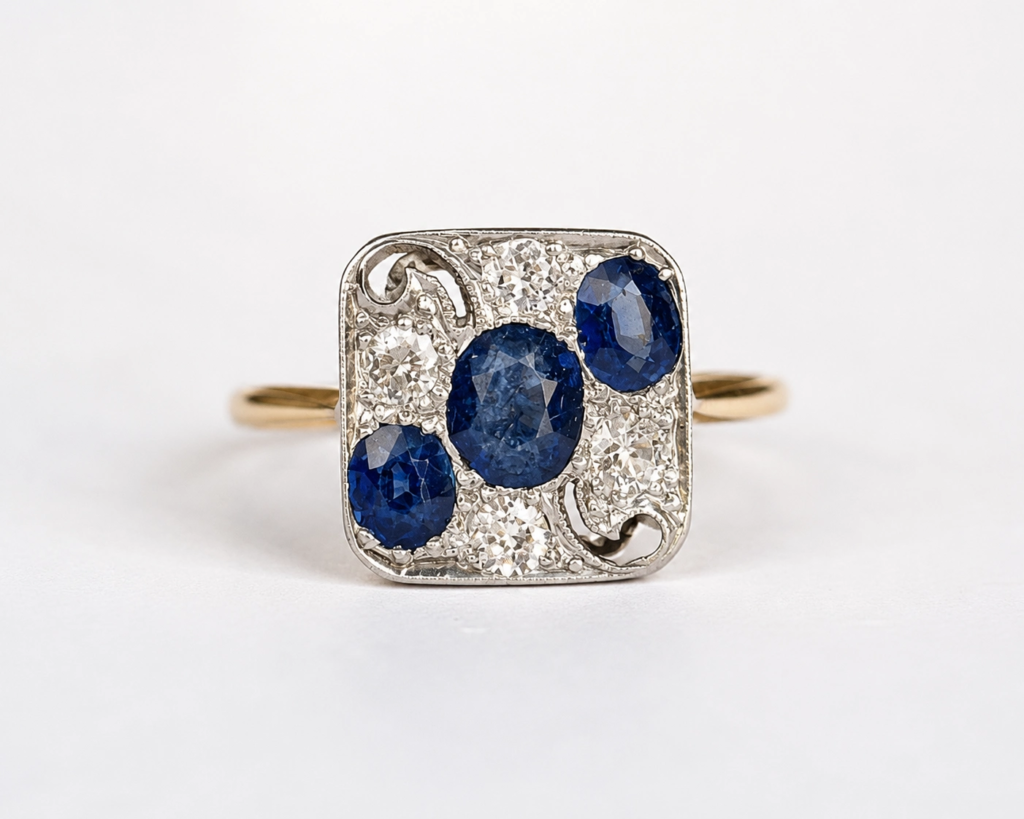
Art Deco jewellery becomes much more geometric. Think straight lines, symmetry, rectangles, squares, chevrons and strong contrasts.
A useful shorthand is:
Edwardian = lace.
Art Deco = architecture.
It’s an oversimplification, but when you’re first learning to recognise the periods, it’s surprisingly useful.
How Can You Tell if Jewellery Is Art Deco?
Look for:
- Strong geometric shapes
- Symmetrical designs
- Platinum and white gold
- Diamonds
- Contrasting black onyx
- Sapphires, emeralds and rubies
- Millegrain
- French-cut and calibré-cut stones
- Old European and Transitional Cut diamonds
- Architectural, linear designs
Colour could be used particularly effectively. Rows of sapphires, rubies or emeralds might sit alongside diamonds, while black onyx created the dramatic black-and-white contrast now strongly associated with Art Deco jewellery.
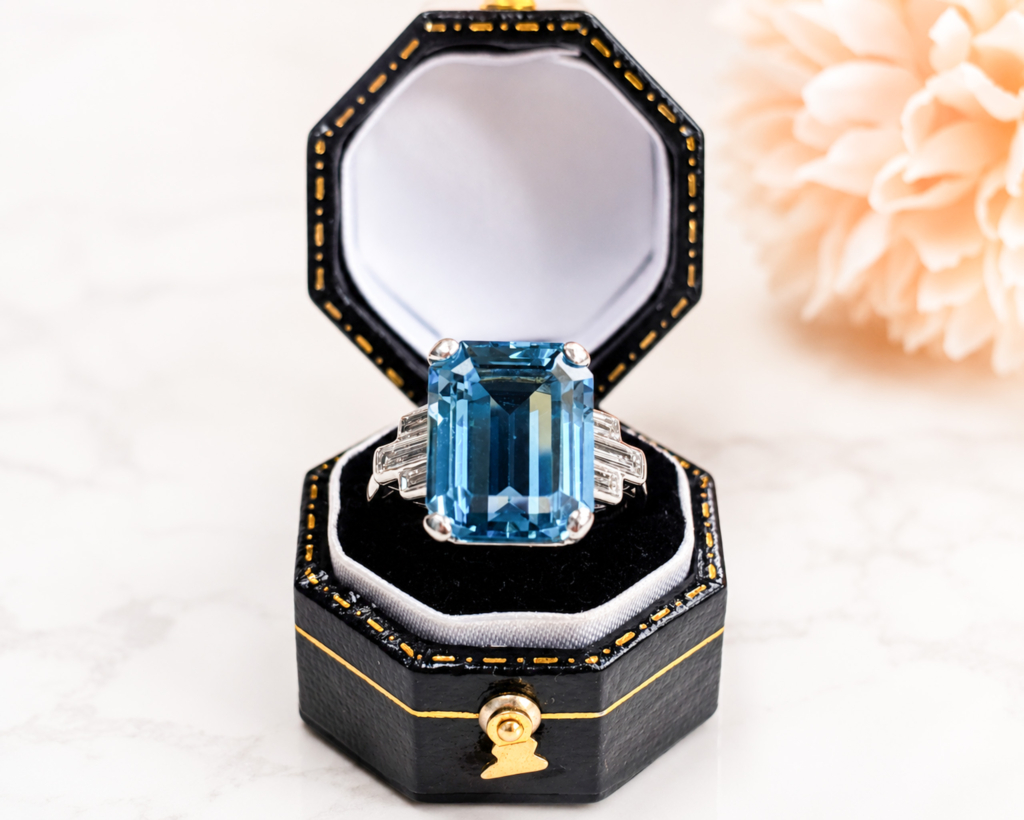
What are French-cut diamonds?
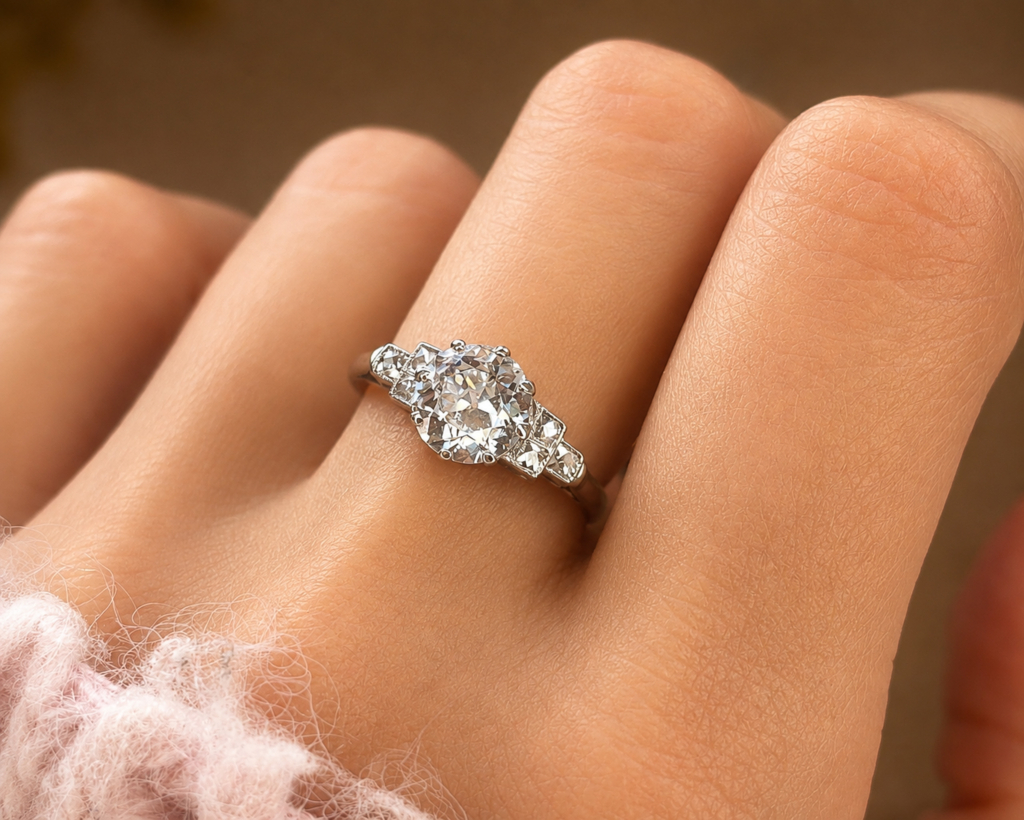
French cuts are usually square or rectangular stones with a distinctive geometric crown faceting pattern.
They were particularly suited to Art Deco jewellery because they could be arranged neatly in rows and geometric designs.
You may see them used as shoulder stones beside a larger central diamond, for example.
Can an Old European Cut diamond be Art Deco?
Absolutely.
This is something that can cause confusion because people sometimes assume the age of a diamond cut must correspond exactly with the age of the jewellery.
Old European Cuts emerged before the Art Deco period but continued to be widely used during it. A 1920s Art Deco ring can therefore quite legitimately contain an Old European Cut diamond.
During the 1920s and 1930s, diamond cutting continued to evolve, eventually producing the Transitional Cuts that bridge the gap between Old European Cuts and the Modern Brilliant.
Victorian vs Edwardian vs Art Deco: What Should You Look For?
If you’re trying to identify an antique piece yourself, start with the overall design.
Victorian jewellery often feels romantic, symbolic or decorative, with yellow gold and coloured gemstones appearing frequently.
Edwardian jewellery tends to be light, delicate and predominantly white, with platinum, diamonds, pearls, fine openwork and flowing motifs.
Art Deco jewellery is usually more architectural, with stronger geometry, symmetry and contrasting colours.
Then look closer.
What metal is it made from? How are the stones cut? Is there millegrain? Is the design flowing or angular? Are there hallmarks? Does the construction look handmade?
No single clue should determine the date.
FAQs
Does Antique Jewellery Have to Be Hallmarked?
No.
A hallmark can be enormously useful when dating jewellery, particularly British pieces, but its absence does not automatically mean a piece isn’t antique or isn’t made from precious metal.
Marks can be worn away, pieces can have been resized or altered, and some antique jewellery was never fully hallmarked in the first place.
Hallmarks should be treated as one piece of evidence rather than the sole test of age.
Does an Old-Cut Diamond Mean the Ring Is Antique?
Not necessarily.
Antique diamonds have always been reused.
An Old Mine Cut or Old European Cut diamond may have been removed from an earlier piece and reset decades later. Equally, an antique ring may have had a damaged or lost stone replaced at some point during its life.
This is why we distinguish between the age of the stone and the age of the setting when examining antique jewellery.
Can Antique Jewellery Have Repairs or Alterations?
Yes, and after 100 or more years of wear, it would be unrealistic to expect every antique piece to have survived completely untouched.
Rings may have been resized, claws replaced, shanks strengthened, stones reset and clasps repaired.
The important questions are how extensive those alterations are, whether they have been carried out sympathetically and whether they materially affect the character or integrity of the piece.
What's the Difference Between Antique and Vintage Jewellery?
As a general rule, jewellery is considered antique once it is at least 100 years old.
Vintage is a broader term used for older jewellery that hasn’t yet reached antique age, although exactly how old something needs to be before being described as vintage isn’t universally defined.
That means the boundary moves.
A piece made in 1926 is now 100 years old in 2026 and can legitimately be described as antique, whereas jewellery from the 1940s, 1950s or 1960s would generally be described as vintage.
Is Older Jewellery Always More Valuable?
No.
Age alone doesn’t determine value.
Rarity, maker, materials, gemstones, craftsmanship, condition, provenance, design and desirability all matter.
A relatively modest Georgian piece isn’t automatically worth more than an exceptional Art Deco diamond ring simply because it’s older.
Age is part of the story, not the valuation.
So, How Do You Know What Era Your Jewellery Is From?
Start with the obvious clues, but don’t rely on any one of them.
Look at the overall design. Examine the metal. Look at the stone cuts and settings. Check for hallmarks. Consider how the piece has been constructed.
And remember that antique jewellery doesn’t always fit neatly into a box.
Styles overlapped. Stones were reused. Jewellery was remodelled. Techniques evolved gradually rather than changing overnight.
That’s part of what makes antique jewellery so interesting: every piece has to be read on its own merits.
At Aladdin’s Cave Jewellery, we handle pieces from across these periods every day, and those small clues are often what allow us to begin piecing together the story of when and how a piece was made.


Jessica Spencer
Antique Jewellery Specialist
Jessica Spencer is part of the third generation at Aladdin's Cave Jewellery in Leeds. Her guides are based on the real antique jewellery handled in the shop and decades of family experience.